
Reach people planning the right trip.
Show up for the places, species, experiences, and questions your best-fit guests are already researching — in search results, maps, referrals, and AI answers.
Result / More relevant discovery
Qualified inquiries/Booking confidence/Less repetitive admin
For lodges & outfitters
Canada · United States
Marketing for fishing lodges, hunting camps, and outfitters.Help the right guests find you, understand the trip, trust the investment, and inquire with the details you need.
The business result
The point is not to own a nicer website. It is to help the right people find the lodge, understand the trip, trust the investment, and arrive at the next conversation prepared.
Show up for the places, species, experiences, and questions your best-fit guests are already researching — in search results, maps, referrals, and AI answers.
Result / More relevant discovery
Give a prospective guest enough specific detail, real photography, pricing context, and proof to feel comfortable taking a remote trip seriously.
Result / Less uncertainty
Help people understand the fit before they contact you, then ask for the dates, group size, plan, and trip details your team needs to respond well.
Result / Better-qualified inquiries
Put rates, travel logistics, cabins, equipment, policies, and planning answers in one dependable place that works in-season and after hours.
Result / Less repetitive admin
Pipestone is not selling pages or pixels. It is helping someone commit to a remote, multi-day fishing trip — and helping the lodge turn that interest into a useful conversation.
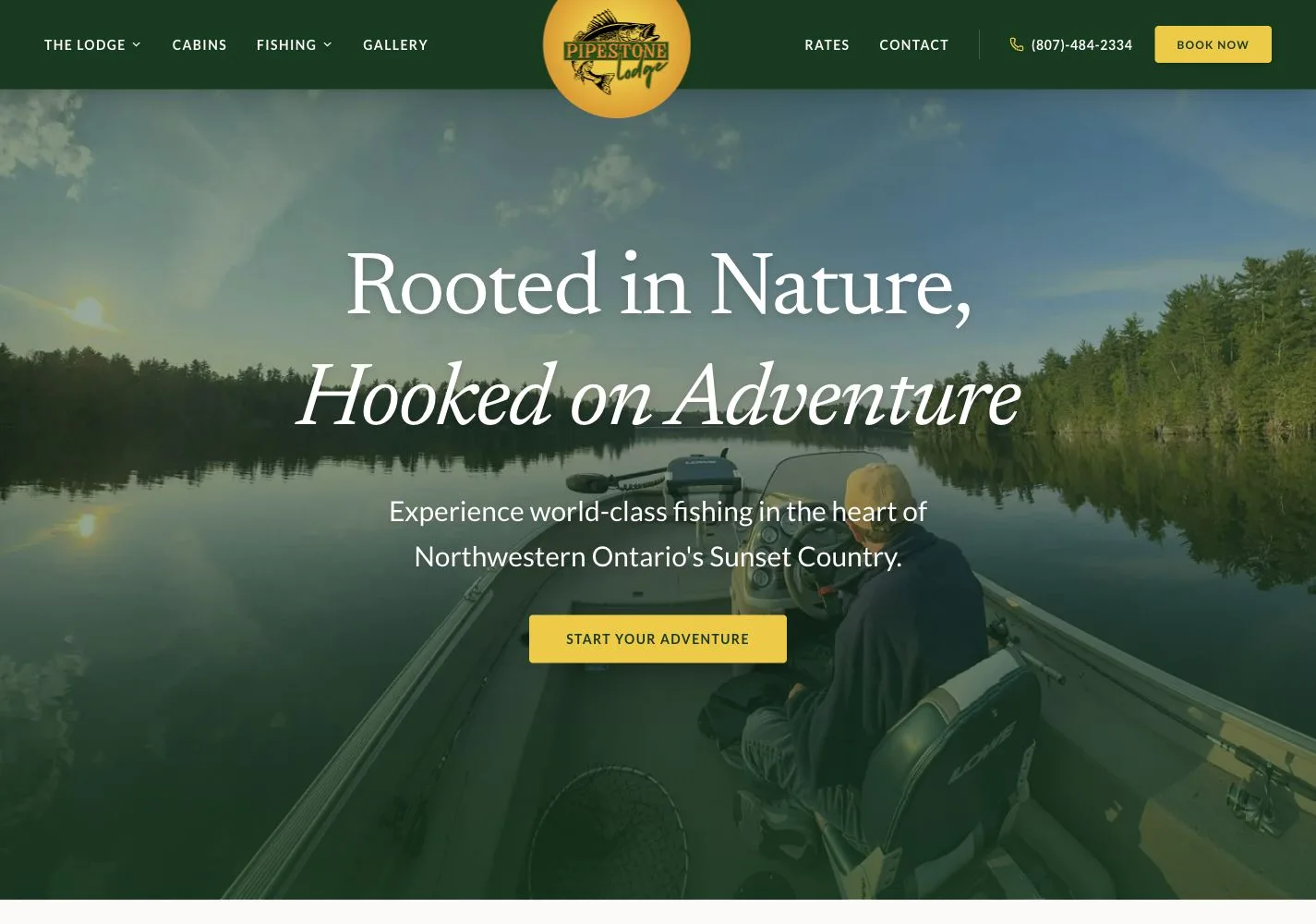
The lake, eight cabins, boats, meals, target species, and real catches make an unfamiliar trip tangible before someone travels.
American and Housekeeping plans, cabin capacities, current rates, inclusions, and add-ons help a group choose the right fit.
Directions, the boat transfer, arrival times, licenses, regulations, gear, and packing guidance remove practical uncertainty.
Persistent phone and booking paths lead to a form that asks for preferred dates and party size — useful details for both sides.
People see the experience, prices, plans, capacities, and travel commitment before asking the lodge to hold dates.
The website handles common questions at any hour, without relying on Keri or the team to explain every detail from scratch.
Guest stories, trophy photos, real lodge details, and a professional presentation give word-of-mouth prospects something credible to validate.
Dedicated pages for cabins, fishing, species, rates, and the lodge give search engines and AI systems specific facts to understand and retrieve.
The honest read
Without Pipestone's analytics, we will not claim a booking or revenue number. What we can see is a system designed to replace uncertainty with specific answers — and vague interest with more useful inquiries.
“The site is easy to use, uncluttered and professional, yet it still captures the feel of the lodge.”
Keri Nazvesky · Pipestone Lodge
How the system works
Websites, content, branding, search, and booking tools only matter when they help someone move through this decision with less friction.
Search strategy, Google Business Profile, location and experience pages, technical foundations.
Business result: Relevant people enter the funnel.
Clear packages, cabins, species, seasons, logistics, rates, photography, and mobile design.
Business result: The offer becomes easy to compare.
Guest stories, first-party proof, brand consistency, useful answers, policies, and current information.
Business result: Risk and hesitation come down.
Focused calls to action, useful forms, phone paths, booking tools, tracking, and follow-up.
Business result: Interest becomes a workable lead.
What to measure
Set the baseline before anything changes. Then review signals that connect marketing to clearer demand, stronger intent, and less work for the lodge team.
Working template
Business outcome
What to record
Dates, party size, budget, package fit, and readiness to book.
Review rhythm
Monthly in booking season
Healthy direction
More complete and viable
Business outcome
What to record
The share of qualified inquiries that become a confirmed reservation.
Review rhythm
Monthly in booking season
Healthy direction
Conversion moves up
Business outcome
What to record
Search, maps, referrals, and AI visibility beyond searches for the lodge name.
Review rhythm
Review each quarter
Healthy direction
More relevant non-branded discovery
Business outcome
What to record
Routine questions about rates, travel, packing, equipment, and policies.
Review rhythm
Review during guest season
Healthy direction
Repetition moves down
The decision centre
Direct answers about the business case, the work itself, and how to judge whether it is helping.
Decision area
Decide what success means before discussing design or deliverables.
Start with the bottleneck, not a redesign. That might be too much dependence on referrals, weak shoulder-season demand, inquiries from the wrong groups, price resistance, or hours spent answering the same questions. We establish the priority and a baseline first; the website, content, brand, or search work follows from that decision.
It can improve the conditions that lead to bookings: relevant discovery, a clear offer, credible proof, lower uncertainty, and an easier inquiry path. It cannot fix unavailable dates, an uncompetitive offer, slow follow-up, or a poor guest experience. We treat the website as part of the booking system, not as a revenue guarantee on its own.
Show the price range, package differences, travel commitment, group capacity, season, and what is included before the form. Then ask for dates, party size, preferred plan, target species or activity, and any constraints. The goal is not simply more form submissions; it is more conversations your team can realistically move forward.
Decision area
Understand what actually needs to change and what the work asks of your team.
Not automatically. If the existing site is fast, easy to update, technically sound, and already explains the trip well, focused changes may be enough. We audit the current path from discovery to inquiry, keep what is working, and recommend a rebuild only when the structure or platform is limiting the business result.
It should reduce avoidable repetition, not eliminate the personal conversation that helps close a trip. A strong planning section answers rates, inclusions, arrival, transport, equipment, licenses, meals, deposits, cancellations, and packing. Your team can then spend calls on availability, fit, and the details that actually need a person.
Usually a few focused interviews, access to current rates and policies, your best real photos, and feedback at defined decision points. We gather the operational knowledge early and work around the booking and guest seasons. You remain the source of truth, but writing, structure, design, and implementation do not become your second job.
Most lodge website projects land between $5,000 and $25,000+, depending on strategy, content, brand identity, photography needs, custom features, booking integrations, and ongoing support. We scope the work against the business priority and give you a defined price before work begins.
Decision area
Set a useful baseline and understand how discovery improves over time.
We agree on a small scorecard before launch. Useful measures include qualified inquiries, inquiry-to-booking rate, calls and forms by source, non-branded search visibility, booking value or capacity where it can be tracked, and reductions in repeated guest questions. Traffic is context; it is not the business outcome by itself.
They need clear, consistent, retrievable facts: who you are, where you are, what experiences and species you offer, when you operate, what packages include, and why the business is credible. Dedicated pages, crawlable text, structured data, a maintained Google Business Profile, real reviews, first-party photos, and consistent listings make those facts easier to verify. No one can guarantee a ranking or AI citation.
We verify tracking, watch how people reach and use the site, and keep seasonal facts current. Rates, availability guidance, policies, staff, photos, reviews, and trip-planning information change over time. The useful model is a dependable marketing asset that improves with the lodge — not a launch that is ignored for five years.
Start with the business
We will look at the gap between discovery and deposit, then tell you honestly what is worth changing — and what can stay exactly as it is.
Talk about your booking season